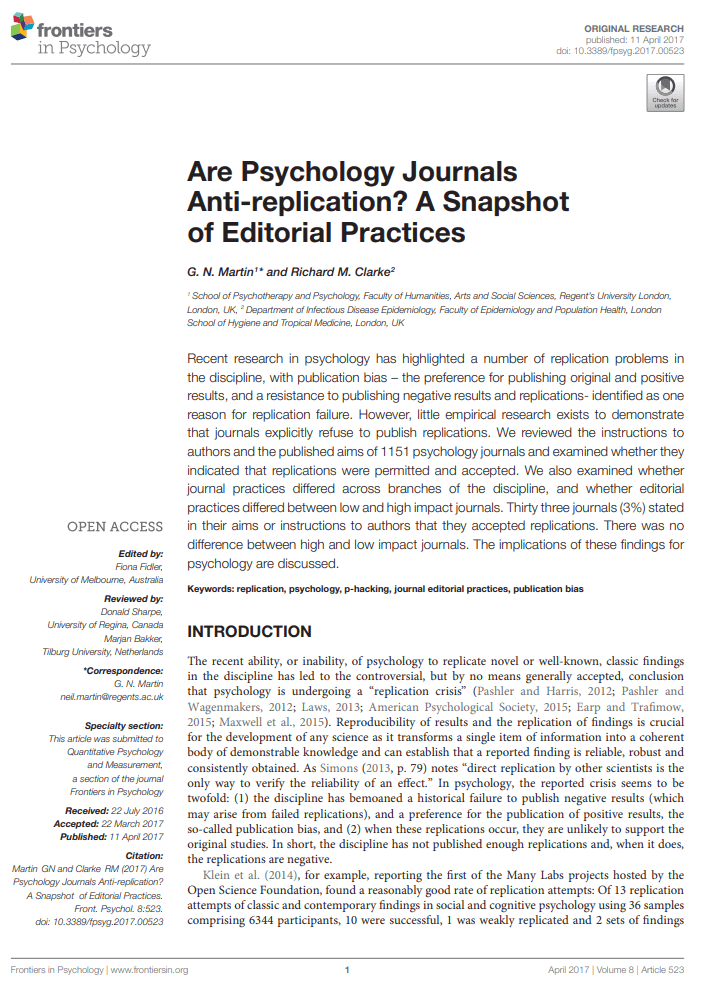
By the mid-2010s, psychology was in the midst of what became known as the replication crisis. High-profile findings were failing to replicate, and attention increasingly turned to the incentives shaping academic publishing. One commonly cited explanation was that journals prioritised novelty and positive results over replication, but there was little direct evidence about whether journals actually discouraged replication studies. This paper set out to examine that claim by looking at what psychology journals explicitly said they were willing to publish.
We systematically reviewed the aims and author guidelines of 1,151 psychology and psychology-related journals to see whether they stated that replications were accepted. We found that only 33 journals, around three per cent, explicitly indicated that they welcomed replication studies. Most journals were silent on the issue, while many implicitly discouraged replication by emphasising originality and novelty. This pattern was consistent across sub-disciplines and did not differ between high- and low-impact journals, suggesting that the issue was structural rather than confined to particular areas of psychology.
Since the paper was published in 2017, the landscape has changed in important ways. Registered Reports, pre-registration, open data, and explicit replication initiatives are now far more visible, and many journals have updated their policies to support reproducible research. At the same time, the core message of the study still holds. What journals signal as valuable shapes researcher behaviour, particularly for early-career academics. Cultural change in science depends not just on better methods, but on clear incentives that reward careful, confirmatory work alongside novelty.
Martin, G. N., & Clarke, R. M. (2017). Are psychology journals anti-replication? A snapshot of editorial practices. Frontiers in Psychology, 8, 523.
 Richard M Clarke (PhD)