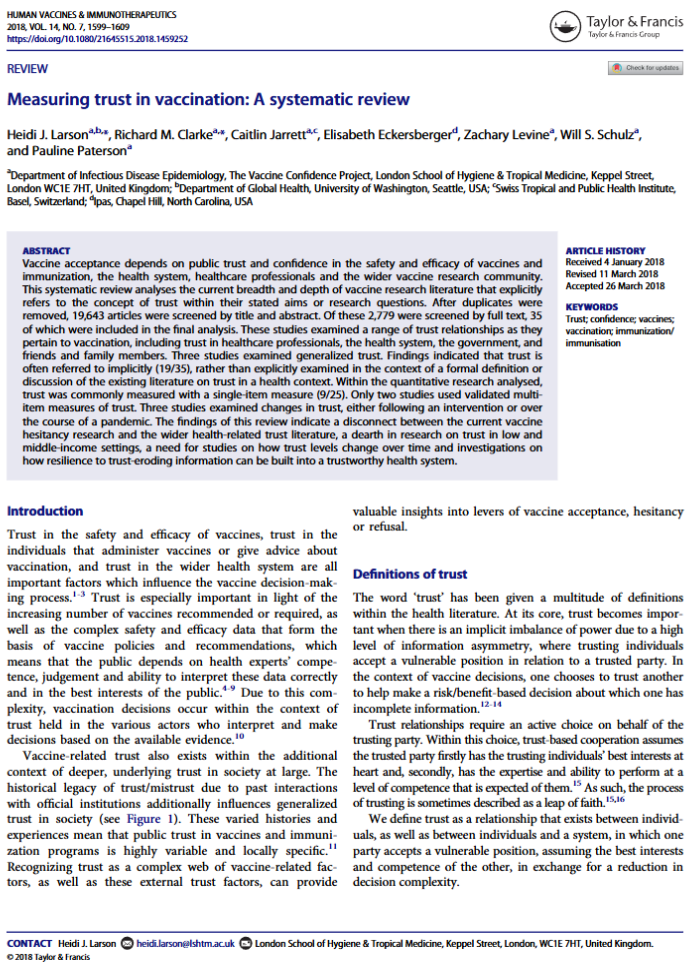
One chapter of my PhD developed into what has since become my most cited paper: Measuring trust in vaccination: A systematic review. At the time, our motivation was straightforward. Trust was repeatedly identified as a key factor shaping vaccine acceptance and hesitancy, yet it was often poorly defined and inconsistently measured across studies. We wanted to take stock of how trust was being conceptualised in the vaccination literature, what researchers actually meant when they referred to it, and whether it was being measured in a way that matched its theoretical importance Measuring trust in vaccination.
To address this, we conducted a systematic review of quantitative and qualitative studies that explicitly examined trust in relation to vaccination. What emerged was a fragmented picture. Many studies treated trust as a single, undifferentiated concept, often measured using one or two bespoke items rather than validated scales. There was considerable variation in whether trust referred to vaccines themselves, healthcare professionals, governments, or health systems, and relatively little attention was paid to how these different forms of trust might interact. The review also highlighted clear gaps in the literature, particularly a lack of work from low- and middle-income countries, despite the central role of trust in global immunisation programmes.
To bring some structure to this complexity, we proposed a conceptual framework to help distinguish between different but related forms of trust. The diagram at the centre of the paper presents trust as a dynamic system rather than a single attitude.
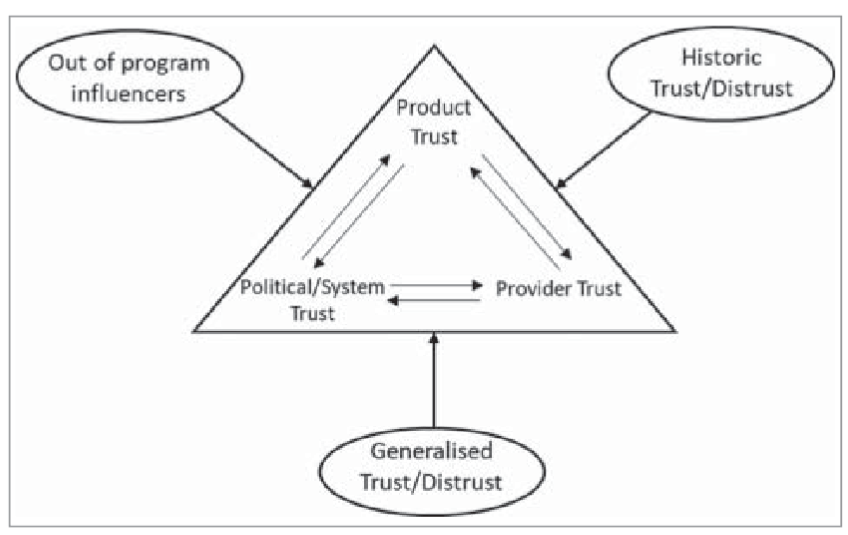
At its core is a triangle linking trust in the vaccine product, trust in healthcare providers, and trust in the political or health system. These elements are shown as mutually reinforcing, with arrows indicating that confidence or distrust in one domain can spill over into others. Surrounding this core are broader influences, including historic experiences of trust or mistrust, generalised trust in institutions and society, and out-of-programme influencers such as media, social networks, and public figures. The framework was intended as a practical tool to guide both measurement and interpretation, emphasising that vaccine decisions are embedded within wider social and historical contexts.
Larson, H. J., Clarke, R. M., Jarrett, C., Eckersberger, E., Levine, Z., Schulz, W. S., & Paterson, P. (2018). Measuring trust in vaccination: A systematic review. Human vaccines & immunotherapeutics, 14(7), 1599-1609.
 Richard M Clarke (PhD)