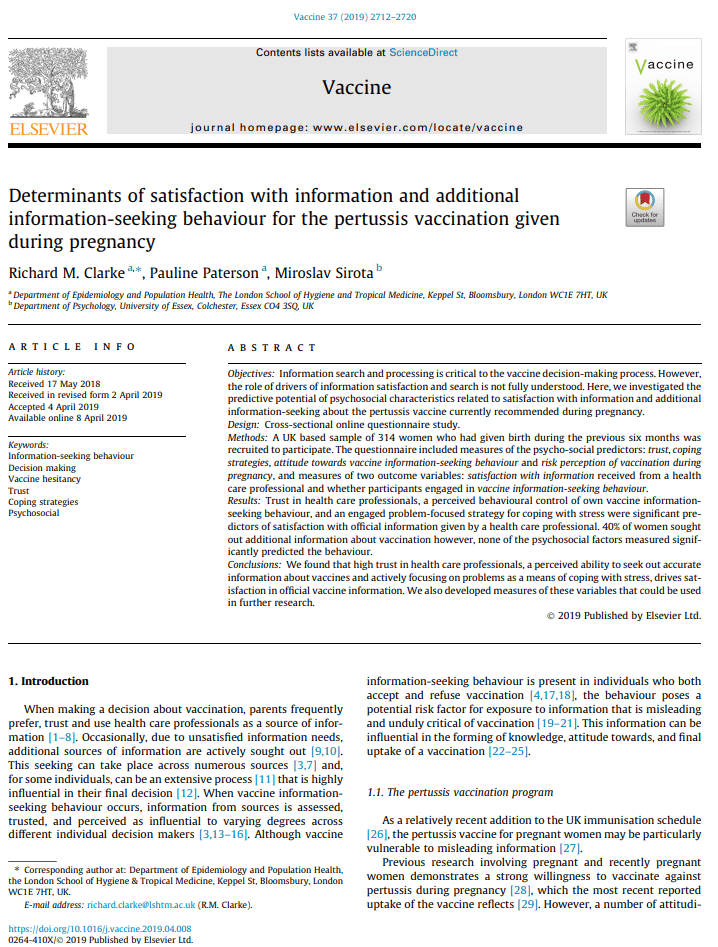
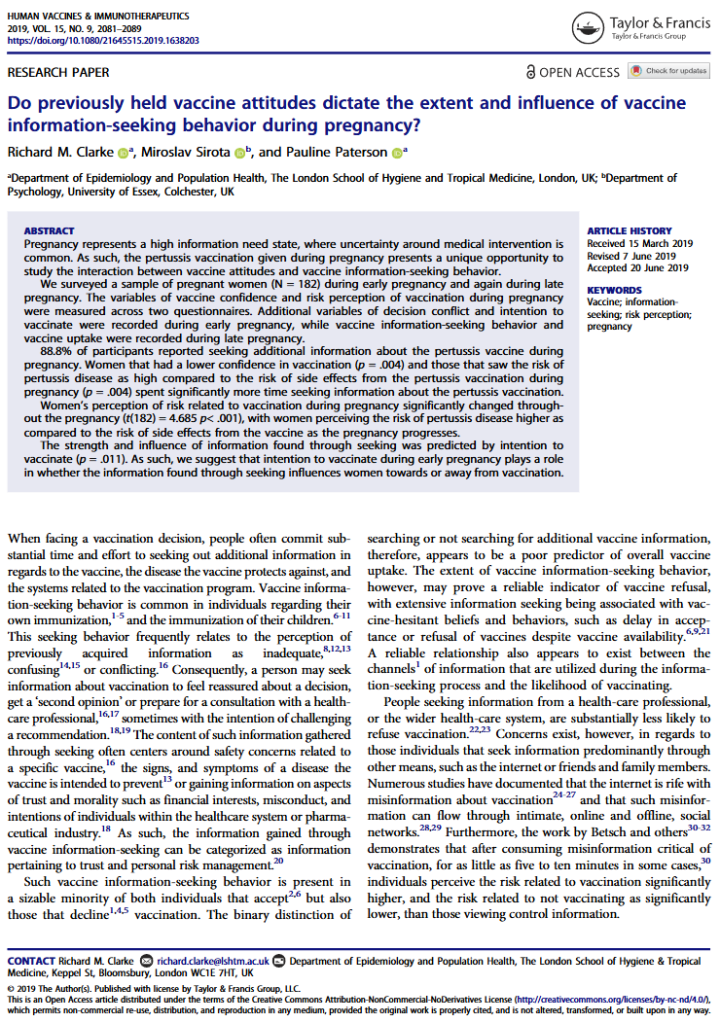
For my PhD, I set out to answer the following question: how do pregnant people make sense of vaccine information when they are deciding whether to take the antenatal pertussis vaccination? Pregnancy is a period of heightened responsibility, uncertainty, and information need, and vaccination during pregnancy sits at the intersection of trust, risk, and decision making. At the time, much of the vaccine hesitancy literature focused on attitudes or uptake alone. We felt this missed something important: the active process by which people seek out, evaluate, and interpret information, particularly in a context where misinformation is easy to encounter.
In the first paper, we focused on satisfaction with information provided by healthcare professionals and what drives women to look elsewhere for additional information about the pertussis vaccine during pregnancy. We found that information-seeking itself was common, but it was not random or purely driven by confusion. Trust in healthcare professionals, feeling capable of finding and judging information, and adopting a problem-focused coping style were all linked to greater satisfaction with official information. Importantly, seeking additional information was not necessarily a sign of rejection or hesitancy. Instead, it reflected an attempt to manage uncertainty and feel confident in a high-stakes decision.
The second paper followed women across pregnancy to understand how pre-existing vaccine attitudes shaped both the extent and the influence of information-seeking over time. Here, we showed that women with lower vaccine confidence and higher perceived risk spent longer searching for information, but that the direction in which information influenced them depended largely on their initial intention to vaccinate. In other words, information-seeking often reinforced what people already believed. We also observed that perceptions of risk shifted over the course of pregnancy, with disease risk becoming more salient later on, suggesting that vaccine decisions are dynamic rather than fixed at a single moment.
Taken together, these papers argue that vaccine information-seeking during pregnancy should not be treated as a problem behaviour to be discouraged. Instead, it is a normal and meaningful part of decision making under uncertainty. The work highlights why trust, timing, and context matter just as much as the content of information itself. If we want to support informed vaccine decisions, particularly during pregnancy, we need to move beyond simply providing more information and instead understand how people actively engage with it, interpret it, and fit it into their existing beliefs.
Clarke, R. M., Paterson, P., & Sirota, M. (2019). Determinants of satisfaction with information and additional information-seeking behaviour for the pertussis vaccination given during pregnancy. Vaccine, 37(20), 2712-2720.
Clarke, R. M., Sirota, M., & Paterson, P. (2019). Do previously held vaccine attitudes dictate the extent and influence of vaccine information-seeking behavior during pregnancy?. Human vaccines & immunotherapeutics, 15(9), 2081-2089.
 Richard M Clarke (PhD)