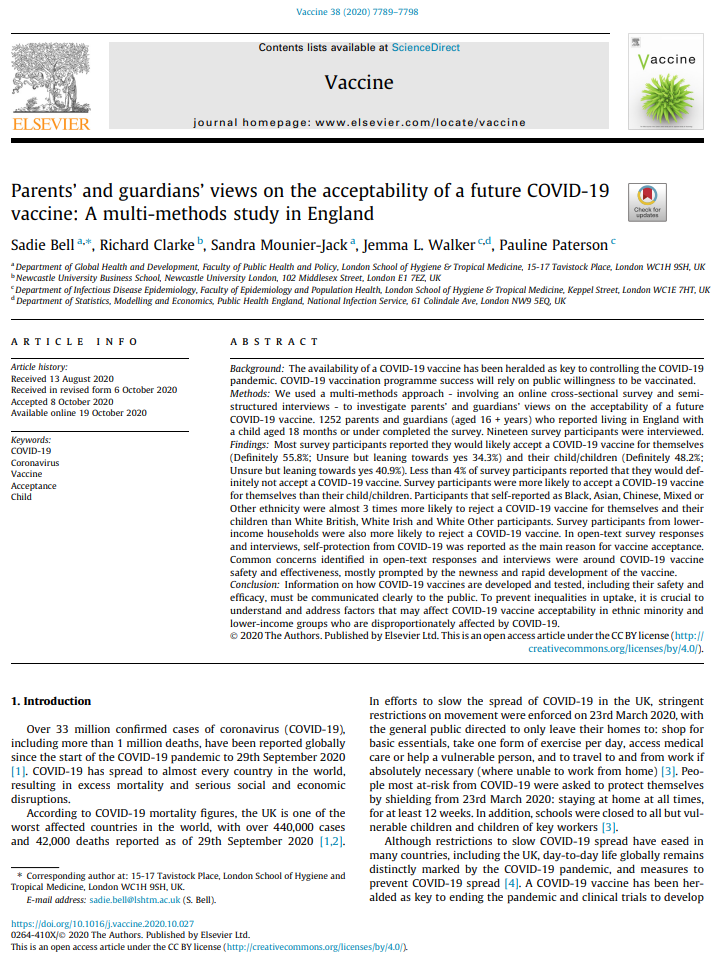
As the first wave of the COVID-19 pandemic unfolded, it became clear that developing a vaccine would only be part of the challenge. Even before any vaccine was available, questions were already emerging about whether people would be willing to accept it, particularly when it came to vaccinating children. The aim of this study was to understand how parents and guardians in England felt about a future COVID-19 vaccine, what might encourage acceptance, and what concerns could act as barriers.
To do this, we carried out a rapid multi-methods study during the first national lockdown in spring 2020. We combined a large online survey of over 1,200 parents and guardians of children aged 18 months or under with follow-up interviews. This approach allowed us to measure overall levels of vaccine acceptability while also capturing the reasoning and uncertainty behind people’s views at a time when very little was known about vaccine safety, effectiveness, or timelines.
Overall, most parents reported that they would be likely to accept a COVID-19 vaccine for themselves, with slightly lower acceptance for vaccinating their children. Protection of family and others was a strong motivator, while concerns centred on safety and the speed of vaccine development. Importantly, lower acceptance was more common among parents from lower-income households and from Black, Asian and minority ethnic backgrounds. The findings highlight that hesitancy was driven less by opposition to vaccines and more by trust and uncertainty, pointing to the need for clear, transparent communication to avoid reinforcing existing health inequalities.
Bell, S., Clarke, R., Mounier-Jack, S., Walker, J. L., & Paterson, P. (2020). Parents’ and guardians’ views on the acceptability of a future COVID-19 vaccine: A multi-methods study in England. Vaccine, 38(49), 7789-7798.
 Richard M Clarke (PhD)