When COVID-19 vaccines were first rolled out in the UK, most people were eager to get protected. But for a small group, the decision wasn’t straightforward.
For people with allergies (or who believed they had allergies vaccination) came with an extra layer of fear. Media stories about allergic reactions, early mixed messages from regulators, and confusing information online left many people asking a simple but deeply personal question: “Is this safe for someone like me?”
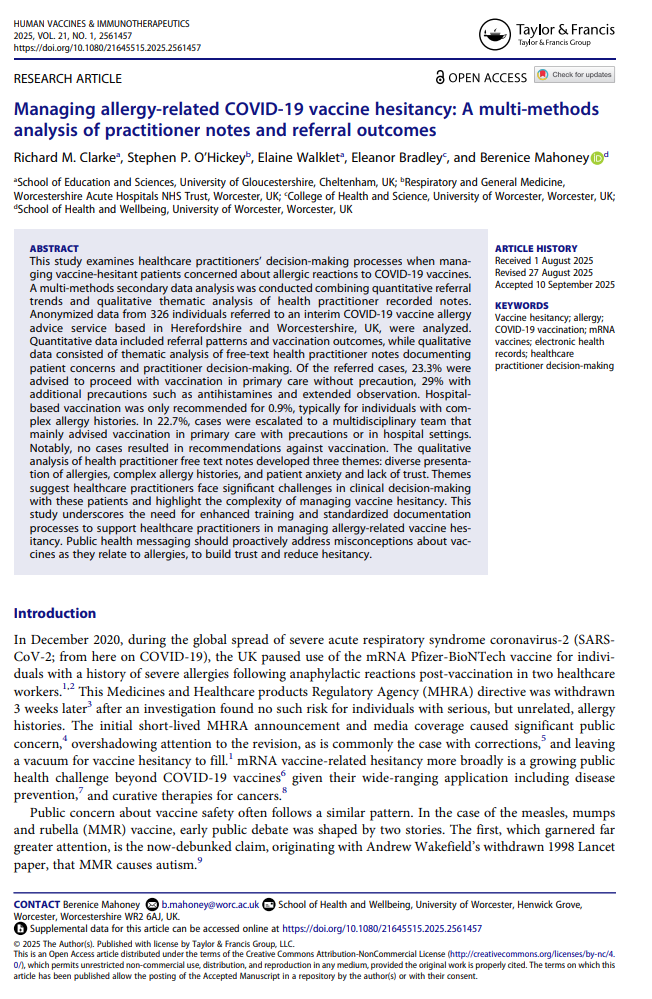
Our recent study looked at how NHS healthcare professionals responded to exactly these concerns during the COVID-19 vaccine rollout, using real-world referral data and clinicians’ notes from an interim vaccine allergy advice service in Herefordshire and Worcestershire
What we found tells an important story about trust, anxiety, and how frontline decision-making really works in public health emergencies.
What was the problem?
Early in the rollout, the UK briefly paused use of the Pfizer-BioNTech vaccine for people with a history of severe allergies. Although this guidance was quickly reversed, the initial message travelled far, and the correction didn’t. As a result, GPs, pharmacists, and vaccination teams were suddenly faced with large numbers of people worried that:
- past allergic reactions (sometimes from childhood) put them at high risk
- ingredients like polyethylene glycol (PEG) could cause anaphylaxis
- vaccination centres wouldn’t be able to help if something went wrong
In areas without a formal NHS allergy service (which is common), this created a bottleneck: Who actually needs specialist care, and who can be safely vaccinated in the community?
What did we study?
We analysed anonymised records from 326 people referred to a COVID-19 vaccine allergy advice service between 2021 and 2022. The data included referral forms completed by healthcare professionals, notes documenting patient concerns and the decisions made by GPs, pharmacists, and multidisciplinary specialist teams
Crucially, these weren’t research interviews, they were real clinical notes, written under pressure during a live public health response.
What did we find?
Very few people actually needed hospital vaccination
Despite widespread fear, almost no one was advised not to be vaccinated. Around 1 in 4 people were advised to vaccinate as normal in primary care. Another 3 in 10 were advised to vaccinate with simple precautions (e.g. antihistamines, longer observation). Only 0.9% were advised to vaccinate in hospital as a necessity. About 1 in 5 cases were reviewed by a specialist multidisciplinary team, most of whom still recommended community vaccination
This matters because it shows that severe vaccine allergy is rare, even among people who are worried they are high-risk.
Allergy histories were often complex or unclear
Healthcare professionals faced a huge range of allergy stories. These included severe reactions decades earlier, self-diagnosed allergies with no clinical confirmation, reactions to food, cosmetics, antibiotics, insect stings, or unrelated vaccines and anxiety-related symptoms that felt physical and frightening
In many cases, clinicians had to decide without clear test results or consistent records. That uncertainty often led to referrals, not because vaccination was unsafe, but because clinicians wanted to be cautious and supportive.
Anxiety played a major role, for patients and perhaps for professionals too
The notes revealed how strongly anxiety shaped decision-making.
Some people described intense fear of vaccination, even after being reassured it was safe. Others wanted vaccination but only if it happened in hospital, or only after another conversation with a trusted GP.
Healthcare professionals were often trying to balance respecting patient fears, avoiding unnecessary medicalisation and keeping vaccination moving during a public health emergency
In some cases, symptoms reported after vaccination were likely linked to anxiety rather than allergy, something the World Health Organization describes as immunisation stress-related responses.
Why does this matter beyond COVID-19?
mRNA vaccines are now being developed for a whole range of immunisations, future pandemics, and treatments. If allergy-related fears aren’t addressed clearly and consistently, the same patterns of hesitancy will repeat.
Perhaps the most important insight from this study is that vaccine hesitancy wasn’t driven by rejection of science. Many of the people in these records wanted to be vaccinated. What they wanted first was reassurance, from someone they trusted, that it was safe for them.
Understanding and supporting that process is essential if we want future vaccination programmes to be effective, equitable, and humane.
This blog post is based on Clarke et al. (2025). Managing allergy-related COVID-19 vaccine hesitancy: A multi-methods analysis of practitioner notes and referral outcomes. Click the link to read the full open access paper.
 Richard M Clarke (PhD)