Understanding How Pregnant People Seek and Use Vaccine Information

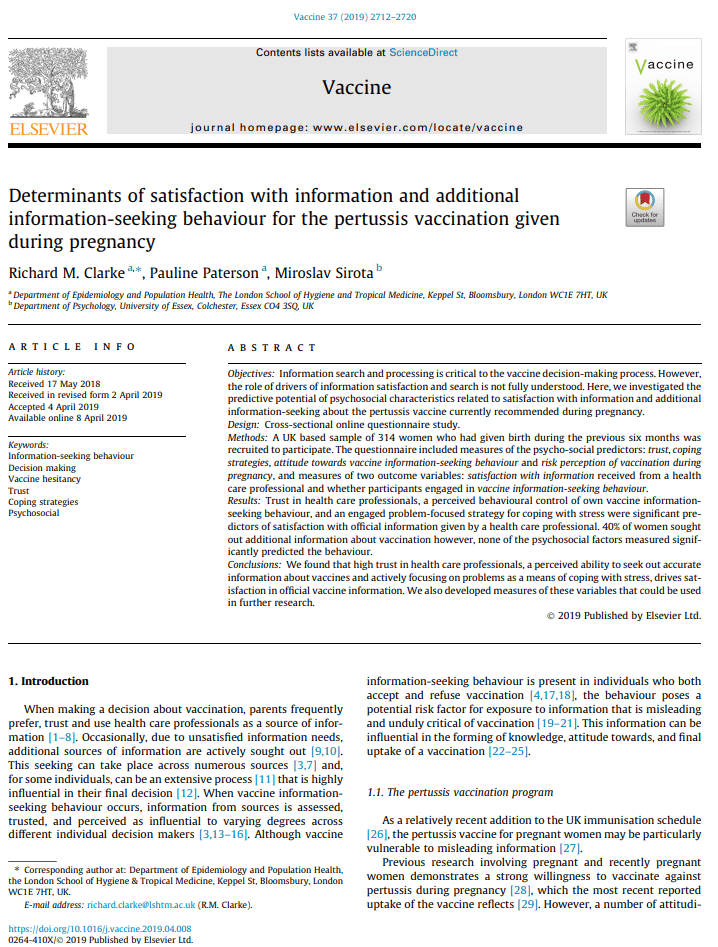
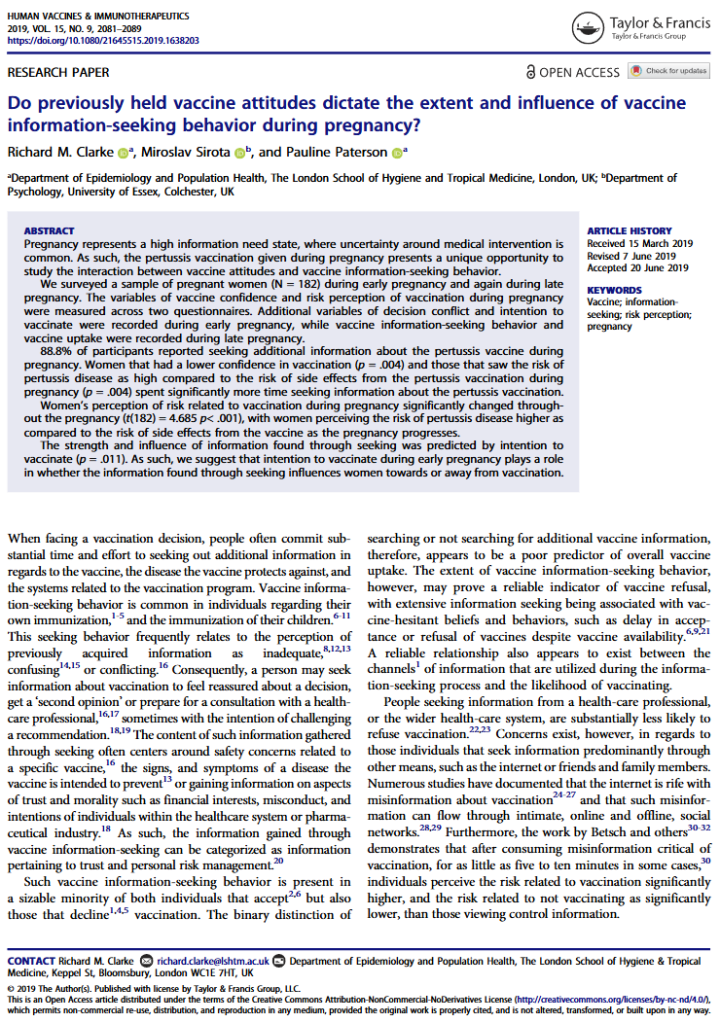
For my PhD, I set out to answer the following question: how do pregnant people make sense of vaccine information when they are deciding whether to take the antenatal pertussis vaccination? Pregnancy is a period of heightened responsibility, uncertainty, and information need, and vaccination during pregnancy sits at the intersection of trust, risk, and decision making. At the time, much of the vaccine hesitancy literature focused on attitudes or uptake alone. We felt this missed something important: the active process by which people seek out, evaluate, and interpret information, particularly in a context where misinformation is easy to encounter.

In the first paper, we focused on satisfaction with information provided by healthcare professionals and what drives women to look elsewhere for additional information about the pertussis vaccine during pregnancy. We found that information-seeking itself was common, but it was not random or purely driven by confusion. Trust in healthcare professionals, feeling capable of finding and judging information, and adopting a problem-focused coping style were all linked to greater satisfaction with official information. Importantly, seeking additional information was not necessarily a sign of rejection or hesitancy. Instead, it reflected an attempt to manage uncertainty and feel confident in a high-stakes decision.

The second paper followed women across pregnancy to understand how pre-existing vaccine attitudes shaped both the extent and the influence of information-seeking over time. Here, we showed that women with lower vaccine confidence and higher perceived risk spent longer searching for information, but that the direction in which information influenced them depended largely on their initial intention to vaccinate. In other words, information-seeking often reinforced what people already believed. We also observed that perceptions of risk shifted over the course of pregnancy, with disease risk becoming more salient later on, suggesting that vaccine decisions are dynamic rather than fixed at a single moment.

Taken together, these papers argue that vaccine information-seeking during pregnancy should not be treated as a problem behaviour to be discouraged. Instead, it is a normal and meaningful part of decision making under uncertainty. The work highlights why trust, timing, and context matter just as much as the content of information itself. If we want to support informed vaccine decisions, particularly during pregnancy, we need to move beyond simply providing more information and instead understand how people actively engage with it, interpret it, and fit it into their existing beliefs.

Clarke, R. M., Paterson, P., & Sirota, M. (2019). Determinants of satisfaction with information and additional information-seeking behaviour for the pertussis vaccination given during pregnancyVaccine37(20), 2712-2720.

Clarke, R. M., Sirota, M., & Paterson, P. (2019). Do previously held vaccine attitudes dictate the extent and influence of vaccine information-seeking behavior during pregnancy?Human vaccines & immunotherapeutics15(9), 2081-2089.

Measuring trust in vaccination: A systematic review

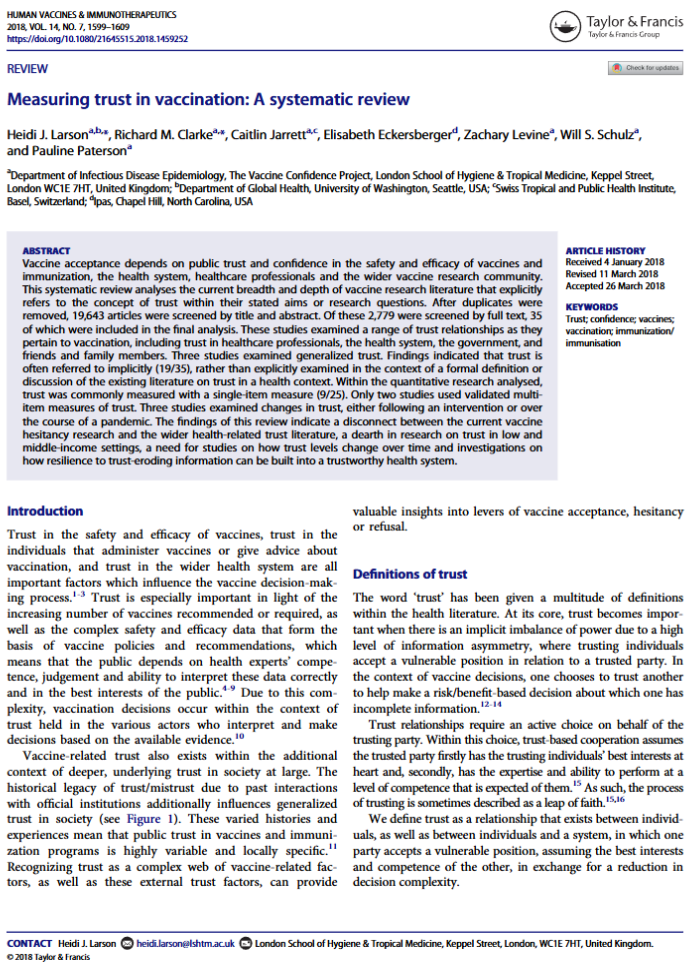
One chapter of my PhD developed into what has since become my most cited paper: Measuring trust in vaccination: A systematic review. At the time, our motivation was straightforward. Trust was repeatedly identified as a key factor shaping vaccine acceptance and hesitancy, yet it was often poorly defined and inconsistently measured across studies. We wanted to take stock of how trust was being conceptualised in the vaccination literature, what researchers actually meant when they referred to it, and whether it was being measured in a way that matched its theoretical importance Measuring trust in vaccination.

To address this, we conducted a systematic review of quantitative and qualitative studies that explicitly examined trust in relation to vaccination. What emerged was a fragmented picture. Many studies treated trust as a single, undifferentiated concept, often measured using one or two bespoke items rather than validated scales. There was considerable variation in whether trust referred to vaccines themselves, healthcare professionals, governments, or health systems, and relatively little attention was paid to how these different forms of trust might interact. The review also highlighted clear gaps in the literature, particularly a lack of work from low- and middle-income countries, despite the central role of trust in global immunisation programmes.

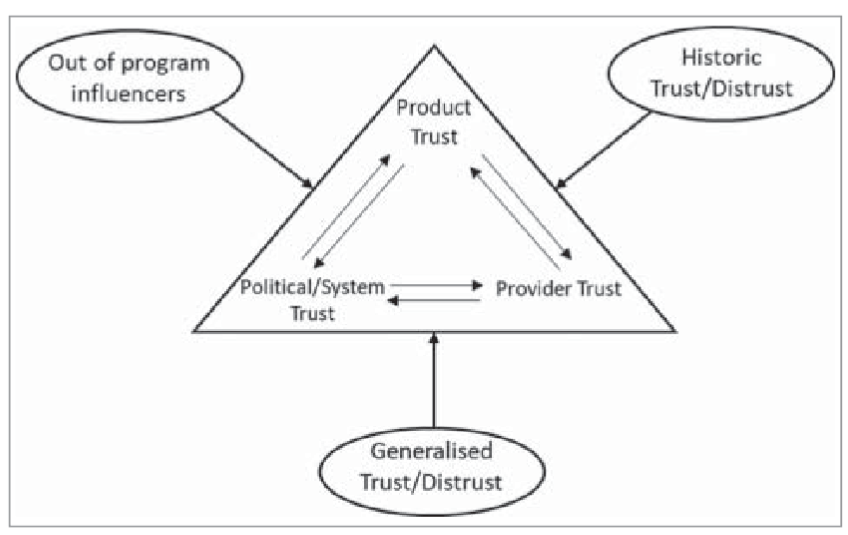
To bring some structure to this complexity, we proposed a conceptual framework to help distinguish between different but related forms of trust. The diagram at the centre of the paper presents trust as a dynamic system rather than a single attitude.

At its core is a triangle linking trust in the vaccine product, trust in healthcare providers, and trust in the political or health system. These elements are shown as mutually reinforcing, with arrows indicating that confidence or distrust in one domain can spill over into others. Surrounding this core are broader influences, including historic experiences of trust or mistrust, generalised trust in institutions and society, and out-of-programme influencers such as media, social networks, and public figures. The framework was intended as a practical tool to guide both measurement and interpretation, emphasising that vaccine decisions are embedded within wider social and historical contexts.

Larson, H. J., Clarke, R. M., Jarrett, C., Eckersberger, E., Levine, Z., Schulz, W. S., & Paterson, P. (2018). Measuring trust in vaccination: A systematic review. Human vaccines & immunotherapeutics14(7), 1599-1609.

Are Psychology Journals Anti-replication? A Snapshot of Editorial Practices

By the mid-2010s, psychology was in the midst of what became known as the replication crisis. High-profile findings were failing to replicate, and attention increasingly turned to the incentives shaping academic publishing. One commonly cited explanation was that journals prioritised novelty and positive results over replication, but there was little direct evidence about whether journals actually discouraged replication studies. This paper set out to examine that claim by looking at what psychology journals explicitly said they were willing to publish.

We systematically reviewed the aims and author guidelines of 1,151 psychology and psychology-related journals to see whether they stated that replications were accepted. We found that only 33 journals, around three per cent, explicitly indicated that they welcomed replication studies. Most journals were silent on the issue, while many implicitly discouraged replication by emphasising originality and novelty. This pattern was consistent across sub-disciplines and did not differ between high- and low-impact journals, suggesting that the issue was structural rather than confined to particular areas of psychology.

Since the paper was published in 2017, the landscape has changed in important ways. Registered Reports, pre-registration, open data, and explicit replication initiatives are now far more visible, and many journals have updated their policies to support reproducible research. At the same time, the core message of the study still holds. What journals signal as valuable shapes researcher behaviour, particularly for early-career academics. Cultural change in science depends not just on better methods, but on clear incentives that reward careful, confirmatory work alongside novelty.

Martin, G. N., & Clarke, R. M. (2017). Are psychology journals anti-replication? A snapshot of editorial practices. Frontiers in Psychology8, 523.